Showing posts with label Copa America. Show all posts

Monday, July 25, 2011

Awakening of a Sleeping Giant


The first real super power in the beautiful game's history was not Brazil, Germany, Italy or Argentina, it was Uruguay. Dating back to 1916, when Uruguay started playing opposition not named Argentina, they dominated the game. That was the first year they took part in a major tournament, and they won it. It was the first edition of the Copa America, held in rival Argentina just like the recently concluded tournament. The second Copa America showed even more of Uruguay's dominance in the early years, they again won it all, this time without losing or drawing a game or conceding a goal. They had played two tournaments and won both, this would not be the last time that they achieved this feat. Uruguay would finally lose a match at the tournament in its third edition but even then it was the final and the game's only goal came after 122 minutes.

Having established themselves in South America, Uruguay took their act international, becoming the first South American team to compete in the Olympics in 1924 in Paris. It was unchartered territory for the team, having only played South American opposition in their history to this point. It didn't matter however as Uruguay won the tournament without losing a match, beating Switzerland in the gold medal match. Four years later Uruguay again headed to Europe to defend their Olympic title, this time in Amsterdam. In the final they met a familiar foe, Argentina, but just as they had done in the Copa America a decade before they won the tournament for the second time, in their second appearance. Uruguay had now made their mark on the world, so much that they were chosen to host a new tournament, the World Cup.

Uruguay 1930 team photo
Uruguay had now made their mark on the early history of the Copa America and travelled to Europe twice and won the Olympic tournament. So they were understandably upset when only four European nations made the trip to their nation to participate in the first World Cup. As they had done with the Copa America and Olympic tournaments, they again won a tournament in their first appearance. They won every game and again faced Argentina in the final. They boycotted the 1934 World Cup in Italy to repay the European nations for not making the trip to South America in 1930. The 1938 World Cup in France was also boycotted by Uruguay, this time because a previous agreement to alternate World Cups between continents had been ignored. World War II followed soon after, so Uruguay had to wait until 1950 to see if they could make it 2 for 2 in the World Cup.

Uruguay scores in the 1950 final
Uruguay won the1950 World Cup, once again without losing a game. They defeated Brazil in the final at the Maracana in what was considered an upset. Regardless, Uruguay had managed to win another tournament in their first two appearances and were clearly a force when it came to international tournament football. They participated at the 1954 World Cup and lost for the first time ever in the Semi Finals versus a Hungarian team that hadn't lost in years. At the end of regulation the score was tied at 2, the Hungarians added on after the 110th minute. Uruguay won their 9th Copa America title two years later but a 5-0 loss to Paraguay prevented them from qualifying for the 1958 World Cup in Sweden. By 1970 they had won 11 Copa America titles and managed a 4th place finish in the World Cup that year, but their dominance over the rest of the world was a thing of the past and the next 40 years was filled with a lot of inconsistant play.

After 1970, Uruguay fell into mediocrity, they qualified for the World Cup every once in a while and when they did they did nothing of notice. The little nation had fallen off as one of the world's super powers and was replaced by Brazil, Germany, Italy and their rival Argentina. As the turn of the century came and passed, Uruguay were barely featured in the world's biggest tournament. A poor showing at the 2002 World Cup was followed by failure to qualify for the 2006 tournament. Then came 2010, a new generation of players and an emergence.

The first round put them in what appeared to be a tough group. They would have to play the hosts, South Africa, a tough Mexican team and 2006 finalist, France. Surprisingly to football purists, Uruguay won the group. They then beat South Korea in the round of 16 putting them in the Quarter Finals. This was further than many had expected the team to make it and it would have been satisfactory. Four South American nations had made it to the stage in all, more than we were accustomed to. Paraguay, Brazil and Argentina were still present. Argentina were then dismantled by Germany, Brazil lost their cool versus the Netherlands and Paraguay blew their chances against Spain. Uruguay however battled Africa's last hope, Ghana, in one of the tournaments most memorable games. The match went to penalties, albeit by some Uruguayan luck, with Ghana missing a penalty in the 120th minute. Uruguay won the shootout and made it to the semi finals, for the first time in 40 years.

Diego Forlan
One man could be given the credit for Uruguay's shock performance at the World Cup, Diego Forlan. He wasn't exactly one of the new generation, having played at the 2002 World Cup, but his performance at the 2010 World Cup was the stuff of legend. Even though Uruguay lost to the Netherlands in the semi finals, Forlan managed to score in both that game and the 3rd place playoff. He was awarded goal of the tournament by FIFA, even though any of his 5 could have been given that honor. He was also awarded the FIFA Golden Ball, given to the tournament's best player overall, quite an honor.

Walter Gargano
Uruguay had finished 4th in the World for the first time since 1970 and there was no feeling of a fluke involved, tough players like Walter Gargano, Diego Perez and Eguren showed quality. Up front Forlan had looked like the world's best but Luis Suarez had emerged as a star and also had a good world cup himself. Muslera in goal turned out to be a very valuable goalkeeper and role players in midfield like Alvaro Pereira emerged in the 2010 World Cup and proved to be as good as advertised. Uruguay had not only finished in their highest position since 1970, they were the highest placing South American team, outranking Argentina and Brazil as well as Paraguay.

Alvaro Pereira
One year later and we are one year removed from the World Cup. One of the most exciting Copa America tournaments in recent memory has just concluded, and Uruguay are the winner. The sleeping giant has emerged, the Copa America title, their first in 16 years, was their record 15th. In all they have won more major titles than any other nation in the world and for the second year in a row have outdone Brazil and Argentina. They now play the beautiful game as well as anyone in the world. Winning the Copa America in Argentina is nothing new for them, but even after the World Cup performance last year not many would have bet on them to win it all. Led by Forlan they have a core of players young enough to continue performing at this level. Players like Caceres in defense have their careers ahead of them, and once Forlan has retired young forwards Luis Suarez and Edinson "El Matador" Cavani look more than capable of carrying on upfront for the next decade. With the next World Cup on South American soil in 3 years, and the Confederations Cup preceeding it, Uruguay are in perfect position to make another strong run in a tournament. The rest of the world better take notice, because the sleeping giants from the tiny nation are back!

El Matador Cavani

Saturday, July 23, 2011

The Penalty Problem

In the past week we've had a lot of football. The 4 Copa America Quarter Finals, the 2 Copa America Semi Finals and a Women's World Cup Final, just to name a few. Of these 7 critical games, 5 of them went into extra time and of those 5, 4 of them went to Penalty Shootouts. So in one week, we had 7 matches that helped decide the eventual outcome of tournaments and more than half were decided by the dreaded shootout. Personally, I love shootouts, the excitement is unrivaled in sports and it tests the composure of players when everything is on the line. When is it too much though? The concept of the penalty shootout has worked so well for so long because we usually only see them in small doses. Between World Cups 1986 and 2010 we've had an average of 3 penalty shootouts per World Cup. 7 World Cups, 21 Shootouts, 112 Knockout Games, That's less than 1 in every 5 World Cup games.


Why are we now seeing more and more penalty shootouts, but why? I've come up with 3 main reasons for this. (1) Parity (2) Conservative Play (3) Refereeing Decisons. Parity is definitely alive in the international game. There was once a clear seperation between the elite nations of the world and everyone else, that seperation is now blurred. Recent penalty shootout matchups that potetially show parity are
Brazil .vs. Paraguay in the Copa America 2011 Quarter Finals and Venezuela vs Paraguay in the Copa America 2011 Semi Finals. In the first matchup we have one of the world's elite in Brazil being held to a goalless draw and eventually losing in a Shootout, in the other we have traditional regional minnows Venezuela holding Paraguay and almost actually winning. In another example involving Paraguay we have the World Cup 2010 Second Round matchup vs Japan, a team that has not ever really been a real Quarter Final quality team. Yet still they were just a shootout away from reaching that milestone just a year ago. 


The fact that Paraguay were involved in so many penalty shootouts may point to another one of my listed reasons, conservative play. Certainly the fact that Paraguay has been in shootouts with everyone from Japan and Venezuela to Brazil may have something to do with their style of play. They may not be intentionally trying to play for penalties but their defensive style of play may give weaker teams the opportunity to. One small fact about Paraguay in those last 3 shootouts is that they've won all 3. They're becoming the Germany of South America when it comes to penalty shootouts and if they're that good at it, why fight the possibility of it? Certainly the factor of conservative play has been around for quite some time where penalties are concerned. That's where the biggest problem lies with the concept of a penalty shootout.

Vizcarrondo
Refereeing decisions certainly play a part in the number of extra time games we seem to be having. What's new though? A missed penalty call there, a disallowed goal here...it's all been seen in the beautiful game. In the recent Venezuela vs Paraguay game, Oswaldo Vizcarrondo put Venezuela up seemingly only to have the goal disallowed for offside. Here we have a weaker team not going the conservative route and playing for the win and having their goal disallowed for an offside call that was debatable at best. The goal would've made history as Venezuela has never made the Copa America final in history. Now if the call was correct and should've been made I stand corrected. From the replays I've seen though it would be very difficult for me to make that call...but of course, I'm no referee. It just seems to me that the officials are in too much of a hurry to make such calls and in games where goals are hard to come by it makes all the difference.

So what's the alternative? As much as I love penalties, the only real alternative would be to get rid of the concept all together. There's nothing we can do about parity, infact we should welcome it, but conservative play and bad refereeing decisions will happen regardless. At the end of the day, the most important of games should not be decided by penalties. If we were to get rid of shootouts the best alternatives I can think of are Silver Goal and the system the MLS used in its early years. Silver Goal is simple, if one team scores in the 1st half of extra time the other team then has to score before the end of that period for the match to continue. If the other team cannot tie the score by the end of that period of extra time, the team that has the lead is the winner. In this case, if the score is tied after extra time we can then use the penalty shootout to settle things. It would definitely throw conservative play out the window in many situations. The second alternative is the former MLS solution. Not much was good in the first years of the MLS but their way of settling ties were fun and made sense. Instead of 5 standard penalties by both teams, we would have 5 shooting opportunities by both teams. Each player would be given 5 seconds to go 1 on 1 with the keeper and attempt a shot. If no shot was attempted in 5 seconds then it counts the same as a miss. This alternative brings a little more of the game into the decider and would be just as exciting for fans. Regardless, we have penalty shootouts for the near future and there's not much that will be done to change that fact. I just hope we get them in smaller doses, so we can enjoy the novelty and hope the better team wins.

Monday, July 18, 2011

The Death of Brazil and World Cup Qualifying

The King is dead! The King is dead! Well maybe not but let's be honest with ourselves, this isn't the Brazil that we've gotten used too. This isn't the attack spearheaded by Ronaldo or Romario. It certainly isn't the creative squad that had Ronaldinho in the middle with his magic, and it definitely isn't the Brazil that put fear into the hearts of every nation across the world.

Ronaldinho circa 2002
 The downfall began at the 2006 World Cup. Ronaldo, the golden boy of the late 90's, had shown up well overweight and the amazing Ronaldinho ended up having a bad tournament by everyone's standards. Their new stars Robinho and Adriano both seemed to have their own personal issues and their defensive problems finally caught up with them. They exited the tournament without reaching the semi-finals for the first time since 1990. Even then Brazil possessed a different breed of player though. An overweight Ronaldo still managed to score 3 times in 5 games at a World Cup. It's hard to imagine any of their new crop of players being able to contribute in that manner.

Ronaldo: early 2000's
After the 2006 tournament the team managed to win the Copa America in 2007 behind a great tournament from Robinho and then the 2009 Confederations Cup in exciting fashion. It would have been easy to consider the 2006 World Cup a fluke, but then came the 2010 World Cup in South Africa. The team again lost in the Quarter Finals. During this tournament the Brazilian downfall was arguably because of the uncharacteristic loss of composure by their players in tough situations. Dunga, who had been coach for the entire cycle was replaced after the tournament. It would have been easy to blame Dunga for the bad performance and he probably did deserve it, but the results have carried over apparently.

The 2011 Copa America on rival ground in Argentina never looked like it would be Brazil's tournament. They started off with a goalless draw with Venezuela, which was shocking for 2 reasons. (1) Brazil did not defeat historical whipping boys, Venezuela and (2) Brazil did not manage to score against historical whipping boys, Venezuela. It was followed by a 2-2 draw against Paraguay, in which Brazil needed an 89th minute equalizer from Fred to get the point. After 2 games they had a draw and a near loss, 2 points from 2 games. This very unBrazilian performance was followed by the group finale against Ecuador. After being tied at 2 goals in the second half, Brazil managed to pull away and win the game 4-2. The group ended with Brazil on 5 points and placed them in a Quarter Final bout with Paraguay. Unlike the first game, which ended 2-2, the Quarter Final matchup was a goalless draw. The second time in the tournament that Brazil failed to score. The match inevitably went to a penalty shootout and the Brazilians lost. Not only did they lose, but they lost without converting a single penalty...out of 4. Elano, Andre Santos and Fred missed the goal completely while Thiago Silva had his shot saved. Very unBrazilian indeed.

Neymar
The new golden boy is the teenager, Neymar. I'm not sure if he'll ever get to the level of the great Brazilians of the past, but he'll definitely be in Brazilian plans for the remainder of this cycle. The next World Cup happens to be in Brazil, so the pressure will be on for them to perform at the tournament. They'll have the luxury of avoiding World Cup qualifying and preparing for the tournament. They will have almost 3 years to build a team capable of winning it all on home soil. We will see how it goes for the Brazilians.

There was a lot of football yesterday other than the Brazil-Paraguay game. There was the Women's World Cup final, which I will get to later. There was a World Cup Qualifying match in the Concacaf region, in which Belize beat Montserrat 3-1 to win the matchup 8-3 on aggregate. They will move on to Round 2 which will be drawn into groups at the big draw in Brazil on Saturday. There was also another Copa America Quarter Final yesterday. Venezuela managed to beat Chile 2-1 to move on to the Copa America semi-final where they will meet Paraguay, not Brazil.

Saturday, July 16, 2011

Matchday Report: Copa America, Women's World Cup

Ahhhh, some things will never change! A year will always be 12 months, we will all die one day and Colombia will always disappoint! Coming into this Copa America I didn't expect much from the Colombians to be honest, but after the first round...I started to believe. Maybe, just maybe, this was going to be the return of top class Colombian football. After all, the team has quite a bit of talent and seemed to have some momentum going into Saturday's Quarter Final matchup with Peru. Peru didn't exactly seem like the toughest of opponents either...but that's why they play the matches. Twenty minutes into the game it was obvious that this was going to be one of those tough matches where goals were going to be hard to come by. At halftime with the score tied at nil the match was playing out exactly in that manner, and the early part of the second half wasn't much different. In the 70th minute an opportunity to break the deadlock arrived when Colombia was awarded a penalty. It was clear this was going to be the type of game that 1 goal would be enough to win, so this was huge! Radamel Falcao stepped up to the spot and promptly sent the kick wide of the goal. Falcao! Colombia's young star with seemingly infinite talent had just missed a penalty with 20 minutes left. At that point I knew they were doomed. Regulation time ended with the score 0-0 as expected and the game proceeded to extra time. This is where Colombia fell apart completely. In the first period of extra time, Peru scored after a free kick was floated into the box causing chaos in the Colombian defence. The Colombian keeper came out to intercept the cross only to fall over Colombian captain, Yepes. The fall caused him to lose the little grasp he had on the ball leaving the goal open. The ball fell to Carlos Lobaton of Peru and he wasted no time blasting a shot into the open net for a Peru goal. Trailing 1-0 into the second period of extra time, Colombia began pushing everything forward with the hopes of finding an equalizer. The urgency was definitely called for but Colombia became erratic. Another goalkeeping error led to Peru sealing the victory. A poor clearance by the keeper fell to a Peruvian player instantly putting them in a 2 on 2 situation. The 2 Colombian defenders stood little chance and Peru scored a very easy goal. Colombia paid for their erratic play and Peru capitalized sealing the victory and earning a spot in the semi-final. Colombia are eliminated, and after the missed penalty and the 2 errors defensively...they have no one to blame but themselves. The talent is there for Colombia to make a serious run at qualifying for the 2014 World Cup however, and hopefully they cease their opportunities better over the next few years.
Radamel Falcao
In the other Quarter Final, Uruguay took on rivals and tournament hosts Argentina. Unlike the previous game, this game was filled with excitement from the start. The atmosphere seemed to be perfect, and the play on the field matched it. The hosts hadn't had a great opening round, but in a knockout match against one of their biggest rivals they were sure to play at their highest level. The crowd was silenced early though, when Uruguay opened the scoring through Diego Perez. A shot deflected into his path just infront of the goal, and with the keeper already beaten it didn't take much of a shot to convert for Perez. With Argentina down 1-0 you would've expected Uruguay to keep the pressure on but the momentum actually switched to the other side. Argentina pressured until they broke the Uruguay defence. Lionel Messi put together an impressive piece of play on the right side and sent a good cross into the box. Gonzalo Higuain beat the offside trap and got to the cross with his head in perfect position to beat Muslera, the Uruguayan keeper. The score was tied at 1 a piece and the game went into halftime.

Diego Perez
Uruguay lost Diego Perez to a second yellow card in the 38th minute and that meant trouble for them. Perez was not only their goal scorer on the day, but he's also a very capable defensive midfielder that would prove valuable in a game of this intensity. They would enter the second half down a man and versus Argentina on any occasion that could be critical. Versus Argentina in Argentina in a knockout round it would usually be too much for most teams to overcome. The second half was filled with the same attacking play that we saw in the first half. Uruguay did well to stay in the game and keep it competitive and Argentina started picking up caution after caution. The first yellow card went to Javier Mascherano in the 50th minute, then as the second round went on Gabriel Milito and Nicolas Burdisso joined him in the referee's book. The winning goal proved to be elusive for both teams however. With extra time looming, the game tied and up by a man, Argentina replaced Aguero with Carlos Tevez. Only 3 minutes later though, Javier Mascherano picked up his second yellow and joined Diego Perez as the ejected players in the game. The game would enter extra time tied at 1 a piece.

Carlos Tevez
Just as the earlier game, we had a game for a spot in the semi final go into extra time. Argentina pushed forward and started creating more chances in the extra periods. Messi was instrumental, and had a chance or two stay out of the goal in situations that could have easily gone his way. A Tevez free kick deflected off the wall and almost set a date with Peru for the Argentinians. Muslera had already dove to the spot he expected the kick to go, only for the ball to deflect to the direction he had dove from. His leg managed to save the shot and a rebound at point blank range was pushed away by Muslera, all in a split second. The game ended deadlocked at 1 goal a piece and we went on to a penalty shootout. Lionel Messi stepped up and converted the first spot kick with ease. Diego Forlan was first for Uruguay and matched Messi. Nicolas Burdisso scored his penalty followed by Luis Suarez for Uruguay. With the shootout tied at 2, neither team had come close to missing when Carlos Tevez stepped up. He shot low and to Muslera's right but the shot was saved. Uruguay had gotten the break they needed. Scotti converted Uruguay's 3rd kick to give them the lead in the shootout. Pastore was next for Argentina, knowing that a miss here would give Uruguay a foot into the semi-final. Pastore went low and to the keeper's right like Tevez had done before him, and Muslera guessed right again. The shot was blocked by Muslera's hand only to deflect into the net. Muslera pounded his fist in disappointment, knowing that a save would have meant Uruguay only needed 1 more conversion. Walter Gargano stepped up and calmly converted for Uruguay to make the shootout score 4-3 in favour of Uruguay. Argentina sent Higuain to take their final kick of the shootout, hoping that he could extend it. He smashed the shot off the bottom of the crossbar, it bounced off the ground and into the net. Uruguay sent Caceres last to win it all for his country. He stepped to the spot and converted the shot with ease. Uruguay won the shootout 5-4 and eliminated their rivals on their home soil. The win means that Uruguay will face Peru in the Copa America semi-finals later this week.

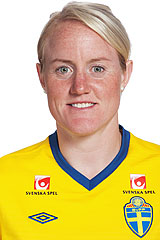
Lotta Schelin
In an update of the Women's World Cup. Sweden managed to beat France in the 3rd place playoff by the score of 2-1. At halftime Sweden led by 1-0 from a Lotta Schelin goal. After the half the French put the pressure on and managed to equalize with a nice shot from just outside the 18 yard box. The shot was kept low and just inside the post to the keeper's right. With 34 minutes left Sweden went on the attack and managed to win the game with a goal in the 82nd minute by Marie Hammarstrom. The goal was a thing of beauty and a nominee for goal of the tournament in an upcoming blog of mine. Both Sweden and France qualify for the Women's football tournament at next year's Olympics. Stay tuned for my next blog for a review of the Women's World Cup final between USA and Japan.
Marie Hammarstrom